Aerospace & Defense Insurance Broker for Manufacturers, Suppliers & Technical Contractors
Aerospace and defense suppliers are not generic manufacturers. Component performance, quality control, contractual indemnity, government requirements, cyber obligations, export controls, and downstream financial consequences need to be part of the insurance strategy. Bryce reviews aerospace and defense programs involving products liability, component performance, product recall, impaired property, professional liability/E&O, contractual indemnity, government contracting obligations, cyber/technology exposure, controlled data, supply-chain risk, quality-control documentation, and downstream financial loss.
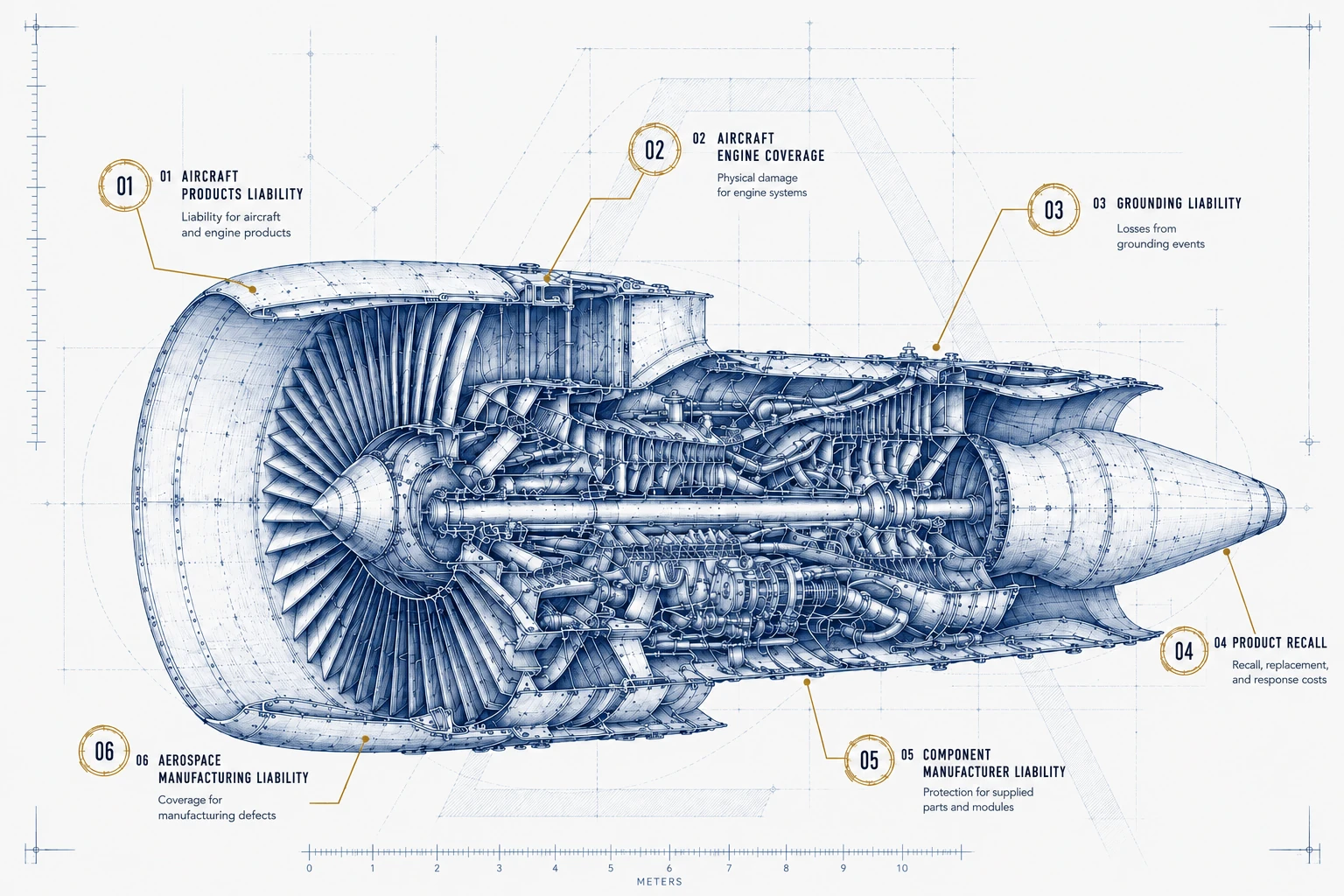
Aerospace and defense segments I build programs around
Each has a distinct products severity profile, a different contractual environment, and a different set of underwriters who will actually quote it.
The full aerospace coverage universe
When I review an aerospace program I work through every category below — not just the lines you currently buy.
Products Liability & Recall
- Aviation & Aerospace Products Liability
- Component Recall & Retrofit Expense
- Fleet Grounding & AD Response Costs
- Completed Operations / Extended Coverage
- Supplier / Sub-Contractor Products
Contractual Indemnity & Defense
- Hold-Harmless & Indemnification Transfer
- Additional Insured / Waiver of Subrogation
- Contractual Liability Assumed
- Prime Contractor / Sub-Contractor Flow
- Bid, Performance & Payment Bonding
Government Contracting
- Defense Base Act (DBA) Workers Comp
- FAR / DFARS Insurance Flowdowns
- CAS & DCAA Audit Exposure
- Foreign Military Sales (FMS) Requirements
- ITAR / Export Control Compliance
Property & Care, Custody & Control
- Manufacturing Facilities & Clean Rooms
- Specialized Tooling, Jigs & Fixtures
- Customer Property in Process
- Business Interruption / Contingent BI
- Test Articles & Prototypes
Cyber & Technology
- Cyber Liability (Data & Network Security)
- Technology Errors & Omissions
- Operational Technology (OT) Manufacturing Risk
- Intellectual Property & Trade Secret
- Classified Environment Exposure
Workforce & Management
- Workers Compensation (Domestic & DBA)
- Employment Practices Liability
- Directors & Officers
- Fiduciary / ERISA
- Crime / Fidelity
My aerospace audit checklist
- 01Whether the product is marketed to underwriters as an ordinary manufacturer or a mission-critical aerospace component
- 02Products severity based on end-use: passenger transport, defense platform, satellite, or ground support system
- 03Recall and grounding coverage scope — first-party recall expense vs. third-party products liability only
- 04Contractual indemnity insurability — hold-harmless assumed from primes vs. legal liability coverage only
- 05FAR / DFARS flowdowns and their specific insurance and indemnification implications
- 06Cyber OT and classified-environment manufacturing exposures
- 07QA discipline, traceability, and NDT documentation that underwriters and primes will review
How I position your account with underwriters
I position the account around what the component does, not what it is. Underwriters need to understand the control environment, the quality documentation, and the contractual obligations that flow down from the prime.
Aerospace underwriting is not commodity pricing. The same CNC-machined fitting can be a low-severity ground-support part or a flight-critical structural component — and the coverage, premium, and market appetite are completely different. My job is to make sure underwriters see the full picture: your end-use severity, your QA traceability, your contractual indemnity, and your government-compliance posture.
Where aerospace and defense programs usually break
Recurring patterns across component manufacturers, avionics and software suppliers, defense contractors, prototype and novel-technology businesses, and space and mission-systems suppliers.
- Products liability tied to high-consequence platforms
- Product recall, product withdrawal, and impaired property issues
- Failure-to-perform or financial-loss allegations
- Contractual indemnity, flowdowns, and customer insurance requirements
- FAR / DFARS, ITAR, export-control, and defense-contract obligations
- E&O / professional liability for engineering, design, software, or integration work
- Cyber, technology E&O, and software-triggered physical consequence
- Prototype, R&D, testing, and non-standard use cases
- Customer property, bailee exposure, tooling, molds, dies, and materials
- Excess liability alignment over products and contractual exposure
Use cases I structure programs around
The product, the platform, and the contract drive the underwriting story. A few common starting points:
CNC / precision component suppliers
Flight-critical parts, tolerance documentation, quality controls, customer contracts, and downstream product-liability exposure.
Avionics, electronics, and software suppliers
Firmware, system integration, cyber / technology E&O, documentation, and failure-to-perform allegations.
Defense contractors and subcontractors
FAR / DFARS flowdowns, contractual indemnity, customer requirements, controlled data, and government-contract obligations.
eVTOL, UAS, autonomous, and prototype businesses
Testing, novel technology, R&D, bodily-injury severity, product liability, and investor / customer contract pressure.
Satellite, space, and mission systems suppliers
Specialty components, launch-related severity, contractual liability, delay, and high-value downstream use.
Bryce Lockerson · AMA Risk
Specialty Broker at Cothrom Risk & Insurance Services · U.S. Navy Veteran · ADCI Member · Based in Fort Lauderdale, FL.
ITAR, FAR/DFARS, export-control, government-contract, and contractual obligations should be reviewed with qualified counsel. AMA Risk reviews these issues from an insurance-program perspective.
Aerospace & Defense insurance questions
Educational answers to common questions about aerospace and defense insurance for manufacturers, suppliers, and technical contractors. Answers are general and do not constitute legal, tax, insurance, or risk-management advice.
Aerospace manufacturers commonly need a combination of aviation/aerospace products liability, completed operations, grounding liability where applicable, product recall and impaired property, professional liability or E&O for design and engineering work, property and inland marine for tooling and inventory, cyber, workers' compensation, and excess. The right structure depends on what the component does, who buys it, where it is used, and what contracts require.
Answers are educational summaries only. They do not modify policy terms, conditions, or exclusions, and they do not constitute legal, tax, insurance, or risk-management advice.
Request an Aerospace & Defense Program Review
Send your current policies, contract flowdowns, product or program specifications, renewal date, and top concern. I'll tell you what else is needed.
Request an Aerospace & Defense Program Review